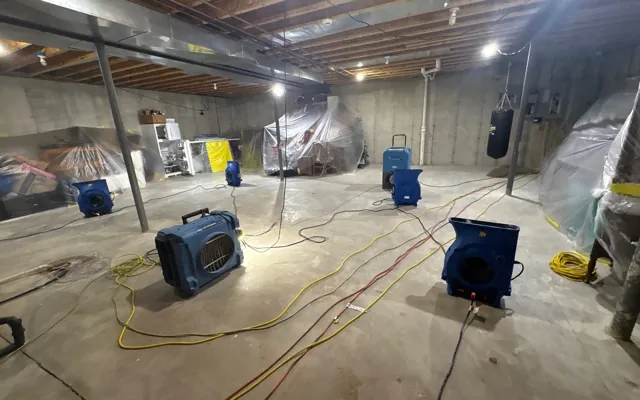
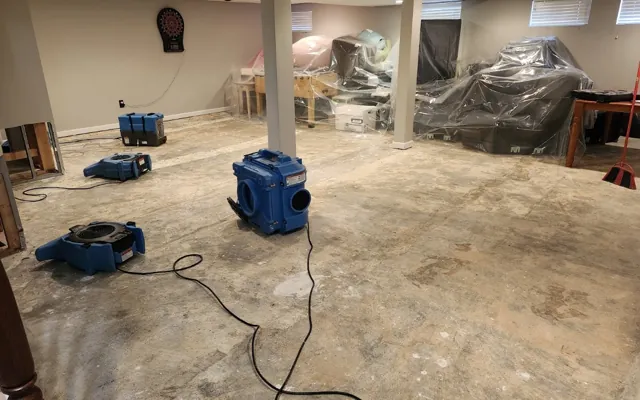
For a basement flood cleanup on Hillsborough Street, NC, local crews respond fast. They pump out the water and dry the structure to IICRC-standard targets, working to prevent secondary damage.

Technicians first use submersible pumps for deep water, then powerful extractors for carpets and hard floors. This rapid removal across the entire basement is critical to stop damage from spreading up the walls.
Soggy drywall, insulation, and carpet padding are cut out and hauled away. This step ensures no hidden moisture is sealed in, which is common in the multi-floor apartments found along this corridor.
Industrial air movers and dehumidifiers run to precise targets. Crews map moisture daily in the enclosed space until subfloors and framing are dry, a standard process for homes in Hillsborough Street, NC.

Lower-level flood cleanup in Hillsborough Street typically runs from about $2,000 to $8,000, depending on the depth of water, how much finished material must come out, and whether the water is clean or contaminated. A shallow clean-water event sits on the low end, while a deep flood with Category 3 water across several rooms sits high. Sudden losses are commonly covered, and crews document each line for the carrier.
Hillsborough Street's mix of old bungalows and dense student apartments means basement flooding can spread fast. Aging plumbing in the older homes or a burst supply line in a stacked unit can quickly send water through a lower level, saturating drywall, carpet, and framing. The red-clay Piedmont soil around Raleigh can shed water toward foundations. On Hillsborough Street, older house foundations and the complex plumbing systems of large apartment buildings both contribute to sudden lower-level flooding events. From Hillsborough Street, crews also cover nearby Cameron Park, Mordecai, Village District, Historic Oakwood, South Park, Oberlin Village. See every neighborhood and town on the full service area page.
See all areas servedEvery loss is photographed, measured, and logged from the first visit, so the paperwork holds up with your insurance carrier.
Technicians follow recognized IICRC drying standards and prove the work with daily moisture readings, not guesswork.
Emergency dispatch any hour of the day or night, with a real crew on the way, not a callback in the morning.
A real crew dispatched any hour, not a callback in the morning.
Trained technicians following recognized IICRC drying standards.
Truck-mounted, portable, and submersible for any size loss.
The loss is documented and billed to the carrier directly.
In Raleigh, costs depend on water depth, contamination level, and how much material must be removed. A shallow, clean water event in one room may be on the lower end of the typical range, while a deep, contaminated flood across several rooms would be higher. Local crews document everything for the claim.
Drying a basement to IICRC standards usually takes several days. The schedule depends on how much water was present, the materials involved, and the local humidity. For homes in Hillsborough Street, NC, crews take daily moisture readings and only finish when the structure itself is dry.
Crews are on call 24 hours a day and can be on the way to Hillsborough Street within the hour.
Call (984) 217-6651