A failed supply line under pressure floods a home fast, whether it feeds a sink, toilet, or appliance. Local crews cut off the spread, extract every gallon, and dry the framing and floors, on site in about an hour, any hour.

The crew confirms the water is shut off at the fixture valve or the main and identifies the failed line, so drying starts against a stopped source rather than a line still under pressure.
Truck-mounted extractors and pumps remove standing water from floors and cabinets, and moisture is traced through walls and into the crawlspace to map the full path of the failure.
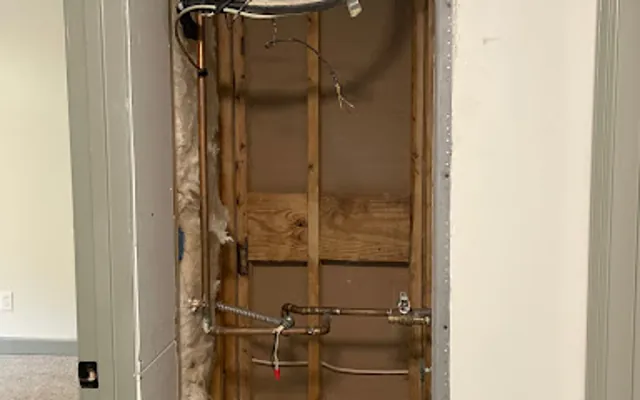
Wet cabinet bases, drywall, baseboards, and trapped insulation are opened where needed, and air movers with dehumidifiers dry the framing and subfloor to an IICRC-standard target.
Moisture meters confirm the framing, subfloor, and cabinets all read dry before equipment leaves, and photos plus the readings are packaged so the insurance claim is well supported.

While help is on the way, these first steps, done only where it is safe, limit the damage and protect the insurance claim.
Shut the supply off at the source, or close the home's main valve if the source is not obvious. Stopping the flow limits the damage more than anything else.
Switch off electricity to the affected area, but only if the breaker can be reached without standing in or touching the water.
Get a crew dispatched right away. The sooner extraction and drying begin, the more flooring, drywall, and belongings can be saved.
Take photos and a short video of the water and the affected rooms before anything is moved, so the insurance claim starts strong.
A supply line failure in Raleigh usually runs from about $1,500 to $7,000, depending on how long the line ran before it was shut off, how many rooms and levels the water reached, and how much material must be opened and dried. A quick shutoff limits the cost, while an all-day failure in an empty home sits high. Sudden line failures are commonly covered, and crews document the source and the readings.
Crews reach Raleigh and Wake County fast, from Historic Oakwood, Five Points, and Mordecai to nearby Garner, Knightdale, Morrisville, Apex, and Wake Forest. See the full list on the areas served across Raleigh page.
See all areas servedEvery loss is photographed, measured, and logged from the first visit, so the paperwork holds up with your insurance carrier.
Technicians follow recognized IICRC drying standards and prove the work with daily moisture readings, not guesswork.
Emergency dispatch any hour of the day or night, with a real crew on the way, not a callback in the morning.
A real crew dispatched any hour, not a callback in the morning.
Trained technicians following recognized IICRC drying standards.
Truck-mounted, portable, and submersible for any size loss.
The loss is documented and billed to the carrier directly.
Shut the water off right away, at the fixture valve if you can reach it or at the main if not, since a pressurized line keeps releasing water until it is stopped. Move what you can off the wet floor and call for extraction. The faster the water is shut off and pulled, the less it spreads into walls, floors, and the crawlspace.
The small flexible lines feeding fixtures and appliances are always under pressure and wear out over time. Braided connectors corrode, plastic nuts crack, rubber washer hoses degrade, and compression fittings loosen. In older Raleigh homes, decades-old connections are especially prone to failing, which is why replacing aging supply lines is a smart, low-cost precaution against a sudden flood.
Where possible, yes. Crews use moisture meters to find exactly how far the water traveled and open only the cavities that read wet, often with small cuts rather than full removal. Drywall, cabinets, and framing that can be dried in place are left, which keeps the repair smaller and the cost down while still reaching the trapped moisture.
A sudden, accidental supply-line failure is one of the most commonly covered water losses on a homeowner policy. Crews document the failed line, the water category, and the moisture readings so the adjuster has clear support, which helps confirm the loss was sudden rather than a slow leak left unaddressed over time.
Raleigh crews are on call 24 hours a day, local and fast, and can be on the way within the hour.
Call (984) 217-6651