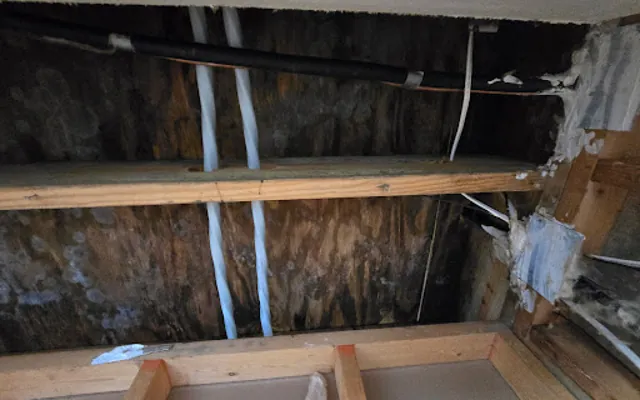
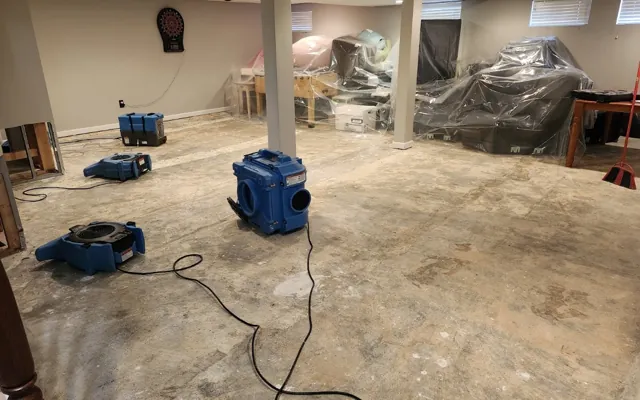
When a roof leak starts in a Village District, NC home, local crews respond quickly to extract water and dry the structure using IICRC-standard methods, aiming to stop further damage from the dampness.

Technicians start inside the Village District home, tracking the stain up into the attic to find where water is getting past shingles or flashing. They verify the roof leak source is being addressed to prevent more water entry.
The crew extracts any standing water from the attic or ceiling cavity. They then carefully open a section of soaked ceiling drywall or remove wet insulation where needed to allow airflow to the damp framing behind it.
Using air movers and dehumidifiers, the team dries the attic space, ceiling cavity, and any affected wall cavities. The goal is to bring all wood and drywall to a dry, IICRC standard target moisture level.

Roof leak water damage in Village District usually runs from about $1,200 to $6,000, depending on how long the leak ran, how far it spread through the attic and walls, and how much insulation and drywall must come out. A small leak caught after one storm sits low, while a long-running leak that soaked framing and ceilings sits higher. Sudden storm losses are commonly covered, and crews document the readings.
In the Village District, aging homes in Cameron Park and Oberlin have plumbing lines running through crawlspaces, while newer apartments have plumbing stacked in walls. A small roof leak here can quickly travel down these paths, wetting ceilings and walls and requiring a thorough local response to find all the moisture. The humid Piedmont climate and seasonal storms test roofs. In the Village District, leaks from worn flashing or storm damaged shingles can run into old attic spaces or down stacked plumbing chases in apartments, spreading water quickly through the structure. From Village District, crews also cover nearby Oberlin Village, Caraleigh, Hillsborough Street, Five Points, Bloomsbury, Cameron Park. See every neighborhood and town on the full service area page.
See all areas servedEvery loss is photographed, measured, and logged from the first visit, so the paperwork holds up with your insurance carrier.
Technicians follow recognized IICRC drying standards and prove the work with daily moisture readings, not guesswork.
Emergency dispatch any hour of the day or night, with a real crew on the way, not a callback in the morning.
A real crew dispatched any hour, not a callback in the morning.
Trained technicians following recognized IICRC drying standards.
Truck-mounted, portable, and submersible for any size loss.
The loss is documented and billed to the carrier directly.
For a home in the Village District, the cost often ranges from about $1,200 to $6,000. It depends on how long the leak ran and how much of the attic, insulation, and drywall got wet. A small leak caught quickly costs less than one that soaked framing over time.
Sudden storm damage is commonly covered. The key is documentation. Local crews provide moisture meter readings and photos showing the extent of the water damage and that the structure was dried to the standard, which supports the claim for Village District homeowners.
Crews are on call 24 hours a day and can be on the way to Village District within the hour.
Call (984) 217-6651